
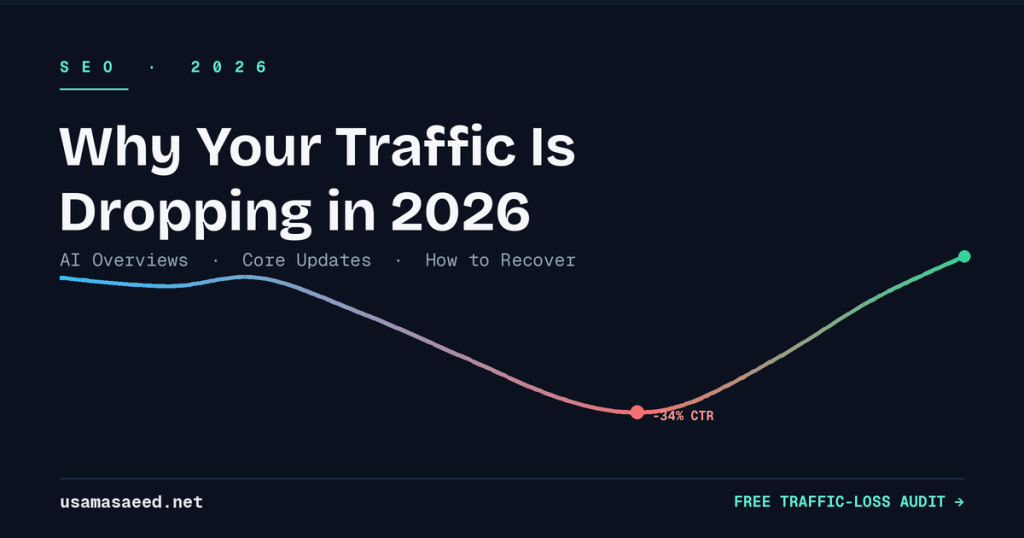
If your website traffic is dropping in 2026, the most likely cause is Google’s AI Overviews answering searches before people ever click through to your site — often compounded by a recent core or spam update and thin, generic content that no longer meets Google’s bar. The good news: this is diagnosable and recoverable. Below is exactly how to find the real cause and the 5-step plan I use to rebuild rankings and leads.
The short answer
Search didn’t stop sending traffic — the rules of visibility changed. Google now summarizes answers at the top of results with AI Overviews, so informational queries that used to earn clicks get resolved without a visit. Industry data through mid-2026 shows AI Overviews appearing on close to half of all tracked searches and cutting click-through rates on top positions by roughly a third, with the worst-hit sites reporting 20–60% traffic declines. Layer a broad core update and a fast-moving spam update on top of that, and a sudden drop starts to make sense.
The opportunity hiding inside this: pages that Google cites inside an AI Overview can actually see higher click-through than before. The game is no longer just “rank on page one” — it’s “be the source Google quotes.”
What actually changed in 2026
- AI Overviews went mainstream. They now trigger on nearly half of tracked queries and are the first thing many searchers read.
- Update cadence sped up. Google pushed multiple core and spam updates in quick succession this year, so SERP volatility is now the norm, not the exception.
- Thin and scaled AI content got hit hardest. Sites leaning on generic, mass-produced posts lost ground; original, expert-driven content stayed stable or gained.
- FAQ rich results disappeared (May 2026), but FAQ schema still matters. The visual Q&A rows are gone, yet FAQPage markup still helps Google understand your page and makes it more likely to be pulled into AI Overviews.
How to tell if AI Overviews are eating your traffic
Don’t guess — check your own Google Search Console. Third-party rank trackers miss AI-surface changes by design, so your GSC data is the source of truth. Do this:
- Open Performance → Search results.
- Filter by Search Appearance and select the AI Overviews and AI Mode segments.
- Compare impressions, clicks, and CTR per segment.
- Find pages with high impressions but almost no clicks. Those are your traffic-loss hotspots — and your citation opportunities.
If clicks fell while impressions held or rose, AI Overviews are likely the culprit. If impressions and clicks both fell together, you’re probably looking at a core-update ranking loss instead — a different fix.
The 5-step recovery play
1. Diagnose before you touch anything
Separate a real ranking drop from a demand dip. Map your decline against the confirmed update timeline. Only act once you know whether this is AI Overviews, a core update, a spam update, or simply fewer people searching.
2. Make your best pages “quotable”
Restructure content so each section can stand alone and be lifted into an AI answer: a direct answer near the top, clear descriptive headings, tight definitions, comparisons, and short factual statements. If a machine can’t cleanly quote a passage, it won’t cite you.
3. Add proof only you have
Original data, real case studies, screenshots, and named author expertise are now the most durable ranking signals. Generic advice that appears on a hundred other sites gets summarized and skipped. First-hand insight gets cited.
4. Fix the technical basics that block AI crawlers
Clean, valid schema (including FAQPage where relevant), fast Core Web Vitals, and content that doesn’t hide behind heavy JavaScript. AI crawlers now make up a large share of Googlebot activity and struggle with JS-heavy rendering.
5. Build brand and E-E-A-T signals
Real author profiles, an about page that establishes credentials, consistent brand mentions, and links from sources people trust. Google confirmed its spam policies now cover AI features — you can’t buy or manipulate citations, so authentic authority is the only path that lasts.
What NOT to do
- Don’t panic-publish more thin AI content — that’s the exact pattern getting suppressed.
- Don’t trust forum “everyone dropped 40%” claims; those are self-reported by the worst-hit sites, not averages.
- Don’t chase loopholes. The durable work — quality, structure, authority — is what survives every update cycle.
Frequently asked questions
Why did my website traffic drop suddenly in 2026?
Usually one of three things: AI Overviews answering queries before the click, a Google core or spam update reshuffling rankings, or thin content that no longer meets the quality bar. Check your Search Console AI segments to confirm which.
Can I still get traffic if AI Overviews answer the question?
Yes. Being the page Google cites inside the Overview can raise your click-through. The goal is citation-readiness: answer-first, well-structured, proof-backed content.
Does FAQ schema still help now that the rich results are gone?
Yes. The visual FAQ rows stopped showing in May 2026, but FAQPage markup still helps Google understand your content and improves your odds of appearing in AI Overviews.
How long does it take to recover lost rankings?
It depends on the cause. Citation and structure fixes can show movement within weeks; recovering from a core-update quality reset is usually a multi-month effort of rebuilding content depth and authority.
Losing traffic? Let’s find out exactly why.
If your rankings or leads have slipped this year, I’ll run a free traffic-loss audit of your site — pinpointing whether AI Overviews, a core update, or on-page issues are behind it, and what to fix first. Book a free audit call and let’s get your traffic — and your pipeline — back.